What is the 3-5-7 rule for packing?
There is a particular kind of freedom that comes from rolling a single carry-on bag through an airport and walking straight past the baggage claim carousel. No waiting, no anxiety about delayed luggage, no wrestling an overstuffed suitcase down cobblestone streets at midnight. For those of us who have made location-independent work a lifestyle rather than a holiday, packing light is not just a preference — it is the foundation of how we move through the world. But getting there, really getting there, requires more than just folding things neatly and hoping for the best.
Over years of moving between cities, co-working spaces, and short-term rentals across multiple continents, most seasoned nomads eventually arrive at the same realisation: packing is a skill, and like any skill, it improves dramatically once you have a framework to lean on. The 3-5-7 rule is one of those frameworks — elegant in its simplicity, surprisingly powerful in practice. But before we get there, it helps to understand the broader ecosystem of packing strategies that experienced carry-on travelers have developed, because they all feed into each other in ways that make your bag feel almost effortless.
Whether you are preparing for a three-week workation in Lisbon or a three-month slow travel circuit through Southeast Asia, the principles here will serve you. Pack them into your thinking the way you pack your clothes — intentionally, with purpose, and with a clear idea of what you actually need versus what you are carrying out of habit or anxiety.
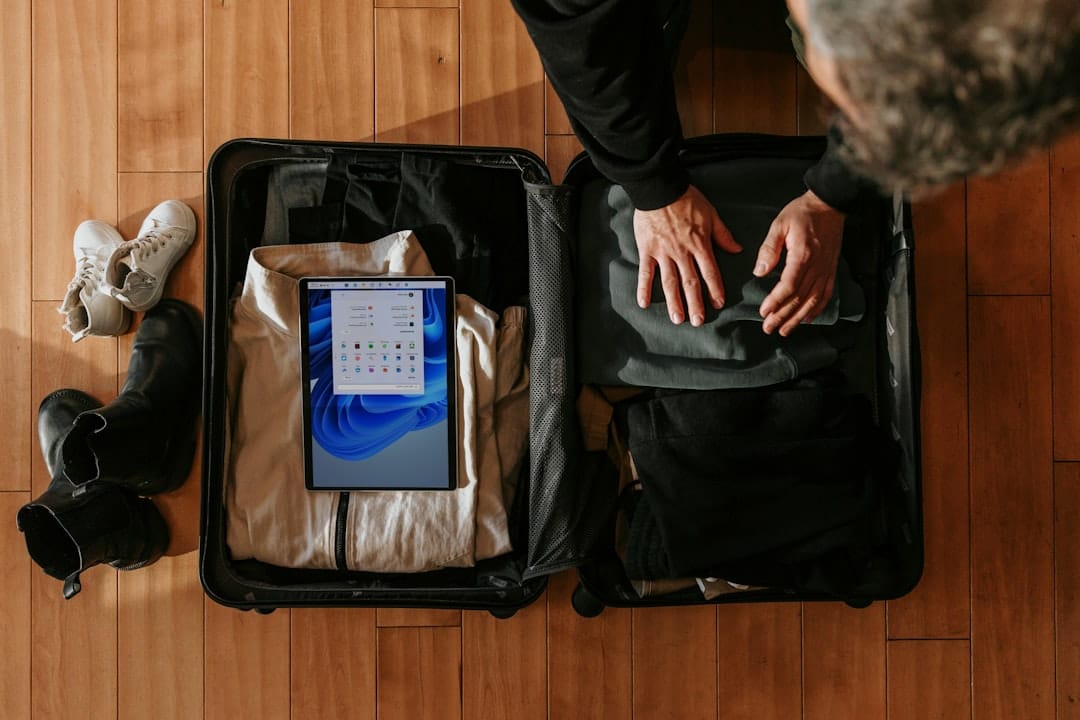
How Experienced Travelers Make Carry-On Only Work
The secret to carry-on only travel is not packing less — it is packing smarter, and then being willing to do laundry. That second part sounds almost embarrassingly simple, but it is the psychological shift that makes everything else possible. Once you accept that you will wash clothes every five to seven days rather than carrying enough for an entire trip, your entire relationship with your bag changes. Suddenly you are not trying to account for every possible scenario. You are packing for a week and trusting that the logistics will follow.
Beyond that mental shift, experienced carry-on travelers share a few consistent habits. They choose bags that maximize the allowable dimensions airlines permit — typically around 55 x 40 x 20 centimetres for most carriers — rather than defaulting to whatever luggage they already own. They invest in quality packing cubes that compress clothing down and keep categories separated so they are not unpacking everything to find one thing. And they build a wardrobe of pieces that are genuinely interchangeable: neutral tones, lightweight fabrics that dry quickly, layers that work across climate shifts. A merino wool long-sleeve, for instance, does the work of three different tops depending on how it is styled.
The other habit worth mentioning is what some travelers call a "test pack" — loading the bag a few days before departure and then actually living out of it at home. You will very quickly discover which items you never reach for, which ones you wish you had included, and whether the bag is actually comfortable to carry when full. It sounds like overkill until you land in a city and realise you have packed three books and no phone charger adapter.
The 5-4-3-2-1 Packing Method Explained
The 5-4-3-2-1 Packing Method Explained
A side-by-side comparison of the 5-4-3-2-1, 3-5-7, and classic packing methods across key criteria for carry-on travel.
| Criteria | 5-4-3-2-1 Method | 3-5-7 Rule |
|---|---|---|
| Suits Carry-On Only | Yes | Yes |
| Outfit Planning Required | Yes | Partial |
| Flexibility for Long Trips | Limited | Full access |
| Shoe Allowance | 1 pair | 3 pairs |
| Learning Curve | Occasional | Standard |
| Best For | Short trips | Recommended |
Before we arrive at the 3-5-7 rule, it is worth spending a moment with one of its cousins: the 5-4-3-2-1 packing trick. This method works by giving you a numbered quota for each clothing category, creating a structured limit that stops the "just in case" spiral before it starts. The numbers vary slightly depending on the source, but a common version runs like this: five tops, four bottoms, three pairs of shoes, two bags or accessories, and one jacket or outer layer. Some versions fold in socks and underwear as their own category counted separately.
What makes this approach appealing for remote workers in particular is that it forces you to think in terms of outfit systems rather than individual pieces. If you are committing to only four bottoms, every pair of trousers or shorts needs to work with at least three of your five tops. That constraint, counterintuitively, produces more creative and versatile packing than a freeform approach ever does. You stop thinking about individual items and start thinking about combinations — which is exactly how a capsule wardrobe works.
The limitation of 5-4-3-2-1 is that it does not scale especially well for very long trips, and it can feel rigid if your itinerary swings between very different climates or social contexts — say, beach days in Thailand and client meetings in Singapore within the same journey. But as a starting framework for a focused two-to-four week workation, it is remarkably effective and worth running through before you zip the bag.
Enjoying this? Get more like it.
Weekly picks for remote workers and digital nomads — tools, destinations, and honest takes, straight to your inbox.
Subscribe free →
Understanding the 3-1-1 Rule and What It Actually Covers
A question that comes up often when people start committing to carry-on only travel is whether the 3-1-1 rule applies exclusively to carry-on bags or whether it also governs checked luggage. The short answer is that it applies only to carry-on. Checked baggage is not subject to the liquid restrictions that the 3-1-1 rule governs, which is why many travelers who do check bags simply pack full-size toiletries without a second thought. In a carry-on world, however, the 3-1-1 rule is non-negotiable.
For those unfamiliar, the rule — established by the TSA in the United States and adopted in similar form by aviation authorities in the UK, Europe, and Australia — requires that all liquids, gels, creams, pastes, and aerosols in your carry-on must be in containers of 100 millilitres or less, all of which must fit into a single transparent resealable bag of approximately one litre in size. One bag, per passenger, presented separately at security. The "3-1-1" shorthand refers to 3.4 ounces (100ml), 1 quart-sized bag, 1 bag per person.
For long-term carry-on travelers, the practical implication is that your entire toiletry routine needs to fit into that one-litre bag — or you need to find solid alternatives. Solid shampoo bars, conditioner bars, solid sunscreen, and toothpaste tablets have all improved dramatically in quality over the past few years and are genuinely worth the switch if you spend serious time on the road. Not only do they eliminate the liquid restriction entirely, they are also lighter and generate less waste. Many nomads who make the switch find they never go back, even when they have access to checked luggage.
The 3-5-7 Rule: A Framework Built for Real Trips
So what is the 3-5-7 rule for packing? At its core, it is a guideline designed to help travelers build a functional, efficient wardrobe for trips of varying lengths without overpacking. The numbers refer to clothing quantities structured around a wash cycle: three outfits to rotate through, five to seven days between laundry sessions. The idea is that you pack enough to wear a different combination each day for roughly a week, then do laundry and repeat the cycle for however long your trip runs.
In more specific terms, the rule typically breaks down into three pairs of shoes (one comfortable walking shoe, one more polished option, one casual or sandal depending on climate), five tops (a mix of short and long sleeve pieces that layer and cross-style easily), and seven days worth of underwear and socks — the items you genuinely cannot rewear without washing. The logic here is sound: shoes take up the most space and weight, so limiting yourself to three is significant. Tops are versatile enough that five covers most combinations. And the seven-day count for undergarments gives you a full week's buffer before you need to find a laundrette or use the hotel sink.
For digital nomads specifically, the 3-5-7 rule works beautifully because it scales to almost any trip length without requiring you to think differently. Whether you are spending three weeks in Mexico City or six months island-hopping, the core kit stays the same — you simply do laundry more frequently, which is both cheaper and less disruptive than you might imagine when it becomes routine. Add your tech essentials — laptop, chargers, cables, a compact travel adapter — and you have everything you need for a life lived well across borders, in one bag that fits in the overhead locker.
The Things Travelers Forget Most Often (And How Not to Be That Person)
For all the planning and framework-building, there is always that one thing. The item that you were absolutely certain you packed and did not, or the thing so obvious it never even made it onto your mental checklist. Travel surveys and nomad communities consistently flag a handful of items as the most commonly forgotten, and they are not particularly exotic — they are the quiet essentials that only reveal their absence at the worst possible moment.
Phone and laptop chargers top the list, closely followed by charging cables and travel adapters — items that feel so obvious they almost escape scrutiny during the packing process. Prescription medications are another common omission, particularly for people whose trips extend unexpectedly. Sunscreen appears on the list with surprising frequency, likely because many travelers assume they will buy it at their destination, forgetting that quality sunscreen abroad can be expensive, hard to find, or formulated differently than what their skin is used to. And then there is the humble but irreplaceable universal travel adapter, which every experienced nomad has either forgotten or lost at some point — usually only once.
The most reliable defence against the forgotten essentials is a master packing list that lives somewhere permanent — a notes app, a shared document, a laminated card if you are the analogue type — and gets checked every single time, regardless of how many times you have packed before. The temptation to trust memory grows with experience, but experienced travelers will tell you that confidence is exactly when the charger gets left on the bedside table. Build the list once, refine it over a few trips, and then use it every time without exception.
Frameworks like the 3-5-7 rule, the 5-4-3-2-1 method, and the discipline of the 3-1-1 toiletry system are not about deprivation. They are about clarity — knowing exactly what you have, where it is, and why it is there. When your entire life for the next month fits into one bag that you never have to check, something shifts in the way you move through airports, cities, and days. You are lighter in more ways than one.
The bag at your feet in that café in Porto or that co-working space in Chiang Mai is not just luggage — it is proof that you have figured out how to carry what matters and leave behind everything that does not. That skill, once learned, changes how you think about a great many things beyond packing.